Reporting Strategy Series – Part 3 of 3
Welcome to the final article in the Afternoons With ACEs Reporting Strategy Series.
In Part 1, we explored the differences between OTBI and SmartView and discussed how each reporting tool serves a distinct purpose within an Oracle Fusion reporting strategy.
In Part 2, we examined reporting personas and demonstrated why executives, managers, finance teams, analysts, and operational users often require very different reporting experiences.
In this final article, we focus on a topic that sits at the heart of many Oracle Fusion implementation successes and failures: the relationship between reporting requirements and solution design.
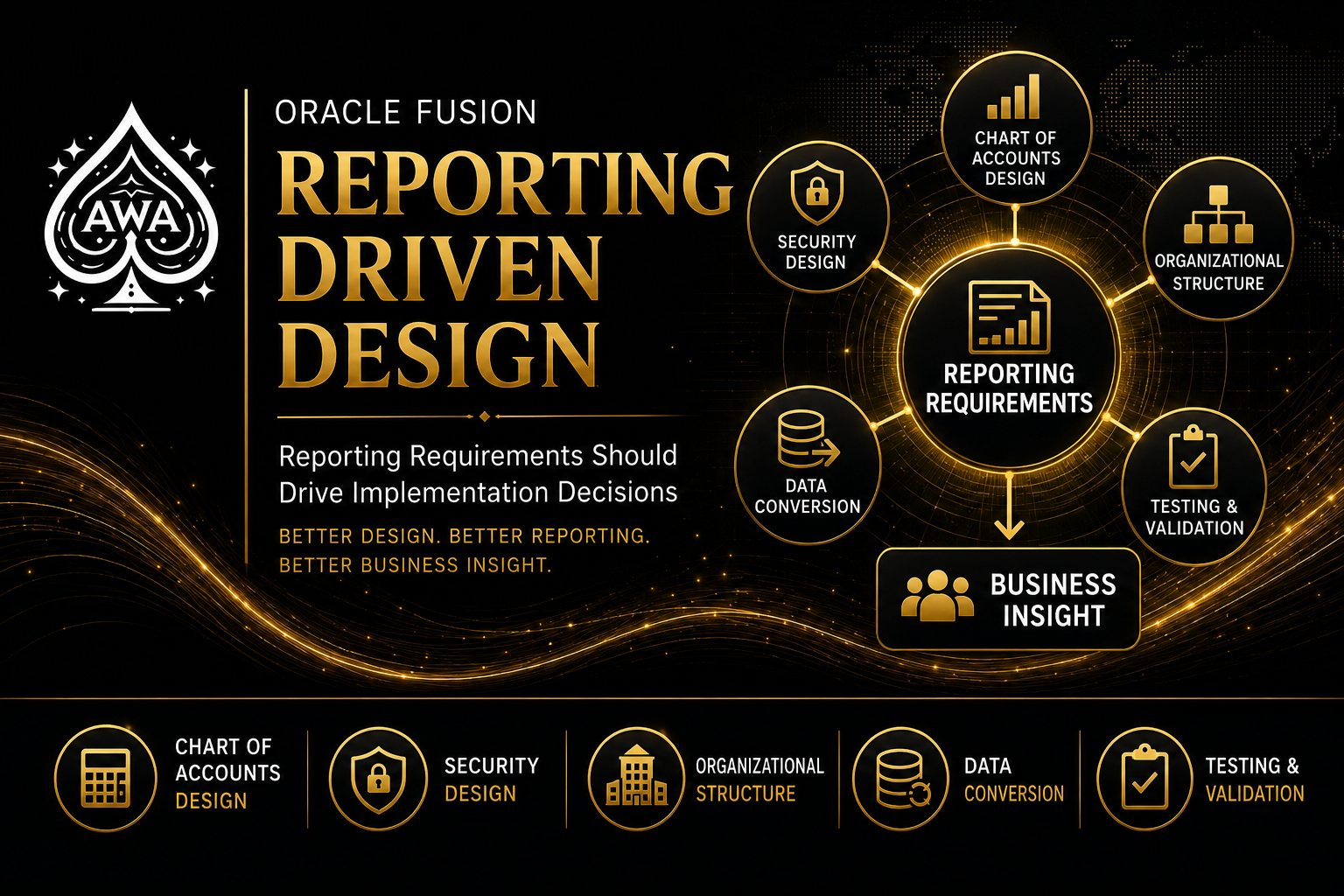
For many organizations, reporting is viewed as something that happens after design decisions have already been made. Project teams focus on process design, security configuration, organizational structures, data conversion activities, and testing strategies. Reporting is often treated as a downstream activity that will eventually consume the information created by those decisions.
Unfortunately, this way of thinking is responsible for many of the reporting challenges organizations encounter after go-live.
Some of the most expensive reporting problems discovered during testing are not reporting problems at all. They are design decisions that have become visible through reporting.
Users do not normally discover Chart of Accounts design issues while entering transactions. They discover them when attempting to produce management reports.
Executives do not normally discover organizational hierarchy issues during configuration workshops. They discover them when dashboards fail to present information in a meaningful way.
Finance teams do not normally discover conversion issues while data is being loaded. They discover them when attempting to perform trend analysis using historical information.
Reporting has a unique ability to expose design decisions that may have seemed perfectly reasonable months earlier.
That is why some of the most successful Oracle Fusion implementations take a fundamentally different approach.
Rather than treating reporting as a project deliverable, they treat reporting requirements as a design input.
The difference may appear subtle, but its impact on implementation success can be enormous.
Reporting Is Where Design Decisions Become Visible
One of the most interesting characteristics of reporting is that it often becomes the first place where business users experience the combined impact of hundreds of design decisions.
During implementation workshops, individual decisions are typically reviewed in isolation.
- A discussion may focus on a Chart of Accounts segment.
- Another workshop may focus on security.
- A separate discussion may address organizational structures.
- Another may address data conversion scope.
Each decision may appear logical when viewed independently.
Reporting is different – Reporting brings all of those decisions together.
A dashboard, financial statement, management report, SmartView workbook, or OTBI analysis becomes the point where users experience the cumulative effect of everything that has been configured throughout the implementation.
This is why reporting often becomes one of the most powerful validation mechanisms available during a project.
When users review reports, they are not simply validating information. They are validating design.
- A management report can quickly reveal weaknesses in Chart of Accounts structures.
- An executive dashboard can expose organizational hierarchy limitations.
- A financial report can identify conversion gaps.
- An OTBI analysis can uncover security issues.
In many ways, reporting acts as a mirror that reflects the quality of implementation decisions.
Organizations that understand this relationship begin asking reporting questions much earlier in the project lifecycle.
Instead of asking “What reports do we need?”, they need to ask “What information will people need to make decisions?”
That question often leads to far better implementation outcomes.
The CFO Doesn’t Care About Your Configuration
One of the simplest ways to understand the importance of reporting-driven design is to consider the perspective of executive stakeholders.
Most executives are not interested in configuration decisions.
- They do not care how security roles were structured.
- They do not care which flexfields were enabled.
- They do not care how subject areas were configured.
- They do not care whether a setup task took five minutes or five days.
What they care about is whether they can obtain the information required to run the business.
A Chief Financial Officer evaluating financial performance is unlikely to praise an implementation because journal entries process correctly.
The CFO is far more likely to judge success based on whether management reports provide meaningful insight.
- Can the organization understand profitability?
- Can business unit leaders compare performance?
- Can management identify risks?
- Can executives make informed decisions?
These are the questions that matter.
The same principle applies throughout the organization.
Users rarely evaluate implementations based on technical accomplishments.. They evaluate implementations based on outcomes.
- Can they access information?
- Can they trust it?
- Can they make decisions with it?
- Can they perform their jobs more effectively?
Reporting is often the lens through which users answer those questions.
This is why organizations that delay reporting discussions frequently find themselves struggling to gain user acceptance later in the project.
Users may not understand configuration decisions, but they immediately understand whether a report helps them do their job.
Reporting Reveals Chart of Accounts Design Decisions
Few implementation decisions influence reporting more than Chart of Accounts design.
When implementation teams begin defining segments, values, hierarchies, and reporting structures, the focus is often placed on transaction processing requirements.
- How should transactions be coded?
- How will costs be captured?
- How will departments be identified?
- How will business units report activity?
These are important questions. However, they are only part of the story. The other question should be “How will management consume information?”
Many organizations discover too late that reporting flexibility is directly tied to Chart of Accounts design.
- A segment that appears unnecessary during design workshops may later become critical for executive reporting.
- A hierarchy that appears sufficient for transaction processing may prove inadequate for management analysis.
- A reporting requirement that was never discussed may require structural changes that are difficult to implement after go-live.
The most successful implementations recognize that Chart of Accounts design is not simply an accounting exercise – It is also a reporting exercise.
Every segment, hierarchy, and reporting relationship ultimately influences how information can be analyzed and presented.
This is why reporting requirements should be discussed before Chart of Accounts decisions are finalized.
Related Resource:
Oracle Fusion Chart of Accounts Design Best Practices
Reporting Reveals Organizational Design Decisions
Reporting also exposes decisions made regarding organizational structures.
Business Units, Legal Entities, Departments, Cost Centers, Ledgers, and other organizational components are often designed primarily to support transaction processing and governance requirements.
However, users rarely view these structures through a configuration lens – they view them through a reporting lens.
- Executives want visibility by business unit.
- Managers want visibility by department.
- Finance teams want visibility by cost center.
- Regional leaders want visibility by geography.
- Business leaders want visibility by organizational responsibility.
When reporting requirements are not considered during organizational design, users often struggle to obtain information in the format they need.
The result is frustration, workarounds, and manual reporting processes.
Organizations that successfully align reporting requirements with organizational structures are far more likely to deliver reporting solutions that users actually adopt.
The objective is not simply to configure organizational structures correctly – the objective is to configure structures that support meaningful business insight.
Reporting Reveals Security Design Decisions
Security discussions frequently focus on risk management, compliance, and segregation of duties. These topics are important and deserve significant attention.
However, reporting requirements must also be considered.
Security controls determine who can see information.
That means security decisions directly influence reporting effectiveness.
- Executives may require visibility across multiple business units.
- Finance teams may need access to information spanning organizational boundaries.
- Managers may need visibility into information outside their direct transaction processing responsibilities.
- Auditors may require controlled access to sensitive information.
When security design occurs without considering reporting requirements, organizations frequently create reporting barriers that frustrate users and limit adoption.
The challenge is not balancing security and reporting – the challenge is designing security that supports both.
Organizations that involve reporting stakeholders in security discussions are often able to achieve stronger governance while still providing appropriate access to information.
Reporting requirements should therefore be viewed as an essential input into security design rather than a validation step performed after security decisions have already been made.
Reporting Is Often the First Real Test of an Implementation
One of the most revealing moments during any Oracle Fusion implementation occurs when business users begin reviewing reports during testing. Up until that point, project teams often feel confident that the implementation is progressing successfully. Configuration has been completed, integrations are functioning, conversion activities are underway, and test scripts are being executed successfully. From a project perspective, everything appears to be moving in the right direction.
Then users begin reviewing reports.
This is often the moment when implementation decisions made months earlier become visible for the first time. Finance teams begin validating financial statements and management reports. Executives review dashboards intended to support strategic decision-making. Managers attempt to analyze departmental performance. Analysts start comparing current information with historical trends. In many cases, the first meaningful discussion about whether the solution truly supports the business begins not during configuration workshops, but during reporting reviews.
The reason is simple. Reports bring together information from every aspect of the implementation. Chart of Accounts structures, organizational hierarchies, security models, data conversion decisions, and business process configurations all converge within reporting. While these elements may have been reviewed independently throughout the project, reporting is often the first opportunity users have to experience how those decisions work together.
This is why reporting frequently uncovers issues that transaction testing never reveals. A user may successfully create an invoice, approve a purchase order, or post a journal entry without noticing any problems. However, when they attempt to analyze that information, compare it to historical performance, or include it within a management report, limitations quickly become apparent. At that point, the conversation is no longer about transactions. It becomes a conversation about whether the implementation supports business decision-making.
Data Conversion Decisions Live On Through Reporting
Few implementation activities generate as much attention as data conversion. Organizations invest significant effort cleansing data, mapping structures, validating records, and reconciling balances. Project teams often view conversion success through a relatively straightforward lens: was the data successfully loaded into Oracle Fusion?
From a reporting perspective, however, that question only tells part of the story.
The more important question is whether the converted data continues to support the reporting requirements that users depend upon. This becomes particularly important after go-live when organizations begin comparing current performance against historical results. Finance teams frequently rely on trend analysis, period comparisons, budget reviews, and management reporting that span multiple years. Executives often want to understand how current performance compares to previous periods. Operational managers may need visibility into historical activity to understand business patterns and identify opportunities for improvement.
When reporting requirements are not considered during conversion planning, organizations can find themselves in a difficult position. Information may technically exist within Oracle Fusion, yet still be insufficient for meaningful analysis. Historical reporting dimensions may no longer align with current structures. Key attributes may have been excluded from conversion scope. Organizational relationships that once supported reporting may no longer be available in the same form.
None of these issues are conversion failures in the traditional sense. Data may have been converted exactly as designed. The challenge is that reporting requirements were never allowed to influence conversion decisions. As a result, users discover limitations only after attempting to perform the analysis required to manage the business.
Organizations that successfully avoid these challenges tend to ask reporting questions early in the conversion lifecycle. They evaluate not only what data should be converted, but how that data will be consumed. They consider future reporting requirements alongside operational needs. Most importantly, they recognize that conversion is not simply about preserving transactions. It is about preserving information.
Related Resource:
Oracle Fusion Conversion Mapping And Validation Best Practices
Why Users Judge Implementations Through Reporting
One of the most interesting aspects of ERP implementations is that project teams and business users often evaluate success differently.
Project teams naturally focus on project metrics. They measure milestone completion, configuration progress, integration readiness, testing results, and go-live execution. These measurements are important because they provide visibility into project health and help teams manage implementation risk.
Users rarely think about any of those things.
Most users do not care how many configuration tasks were completed. They do not evaluate implementations based on integration architecture. They are not interested in conversion mapping documents or project status reports. Instead, they evaluate the implementation through the lens of their daily responsibilities.
- Can they perform their work?
- Can they find information?
- Can they trust the data?
- Can they answer questions from management?
- Can they make decisions more effectively than they could before?
These questions often determine whether users view an implementation as successful.
This is where reporting becomes so important. Reporting is one of the primary ways users interact with the information generated by Oracle Fusion. It influences decision-making, performance management, operational visibility, and executive oversight. When reporting works well, users gain confidence in the solution. When reporting is difficult, incomplete, or misaligned with business needs, frustration emerges quickly.
Many implementation teams underestimate the relationship between reporting and user adoption. Users may tolerate process changes, new navigation structures, and revised workflows if they believe the system helps them access better information. Conversely, even technically successful implementations can struggle to gain acceptance if reporting requirements are not adequately addressed.
This is one of the reasons reporting should never be viewed as a secondary workstream. Reporting directly influences how users perceive the value of the implementation itself.
Lessons Learned From Oracle Fusion Implementations
Across Oracle Fusion implementations, certain reporting-related lessons appear repeatedly. While every organization is different, the underlying themes remain remarkably consistent.
One of the most common lessons is that reporting discussions almost always occur later than they should. Project teams spend months discussing business processes, organizational structures, and security requirements before engaging in detailed reporting conversations. By the time reporting workshops begin, many foundational decisions have already been made.
Another common lesson is that reporting requirements are frequently assumed rather than documented. Stakeholders often believe their reporting needs are obvious. Finance teams assume management reporting requirements are understood. Executives assume dashboard expectations have been communicated. Operational managers assume transactional reporting requirements will naturally emerge during design discussions. Unfortunately, assumptions rarely produce effective reporting solutions.
Organizations also discover that reporting requirements evolve throughout the implementation lifecycle. Information that appears unnecessary during early workshops often becomes critical during testing. New management reporting requirements emerge. Executives request additional visibility. Business users identify analytical opportunities that were never discussed during requirements gathering. This evolution is entirely normal, but it reinforces the importance of maintaining reporting discussions throughout the project.
Perhaps the most important lesson is that reporting should be viewed as a business capability rather than a technical deliverable. When reporting is treated as a technical workstream, discussions focus on tools, subject areas, and report development. When reporting is treated as a business capability, discussions focus on decisions, insights, performance management, and organizational outcomes. The difference fundamentally changes the way implementation teams approach design.
Building a Reporting-Driven Implementation Strategy
Organizations that consistently deliver successful reporting outcomes tend to approach implementations differently. Rather than treating reporting as something that will be addressed later, they use reporting requirements to help guide decision-making from the beginning.
This starts with understanding how information supports the business. Reporting workshops focus not only on reports, dashboards, and analytics, but also on the decisions those tools are intended to support. Teams seek to understand what information executives require to manage performance, what visibility managers need to operate effectively, and what analysis finance teams depend upon to support organizational planning.
These discussions naturally influence design decisions. Chart of Accounts structures are evaluated through both operational and reporting lenses. Organizational hierarchies are reviewed based on how information will be consumed. Security discussions consider visibility requirements alongside governance controls. Testing strategies include reporting validation activities rather than focusing exclusively on transaction processing.
The objective is not to allow reporting requirements to dominate every design discussion. The objective is to ensure reporting requirements have a seat at the table whenever important implementation decisions are being made.
Organizations that achieve this balance often experience fewer surprises during testing, stronger user adoption after go-live, and significantly greater confidence in the information produced by Oracle Fusion.
Final Thoughts
The biggest reporting problems discovered after go-live are rarely reporting problems.
More often, they are implementation decisions that have become visible through reporting.
That reality explains why reporting requirements deserve a far more prominent role within Oracle Fusion implementations. Reporting is not simply a collection of dashboards, analyses, and financial statements delivered at the end of a project. It is one of the primary mechanisms through which organizations evaluate performance, monitor operations, identify risks, and make strategic decisions.
When reporting requirements are considered only after design decisions have been made, organizations often find themselves adapting to limitations that could have been avoided. When reporting requirements influence design decisions from the beginning, implementations become more flexible, more scalable, and better aligned with business objectives.
The most successful Oracle Fusion implementations understand that reporting is not the final step in the implementation journey.
It is one of the most important inputs into the journey itself.