
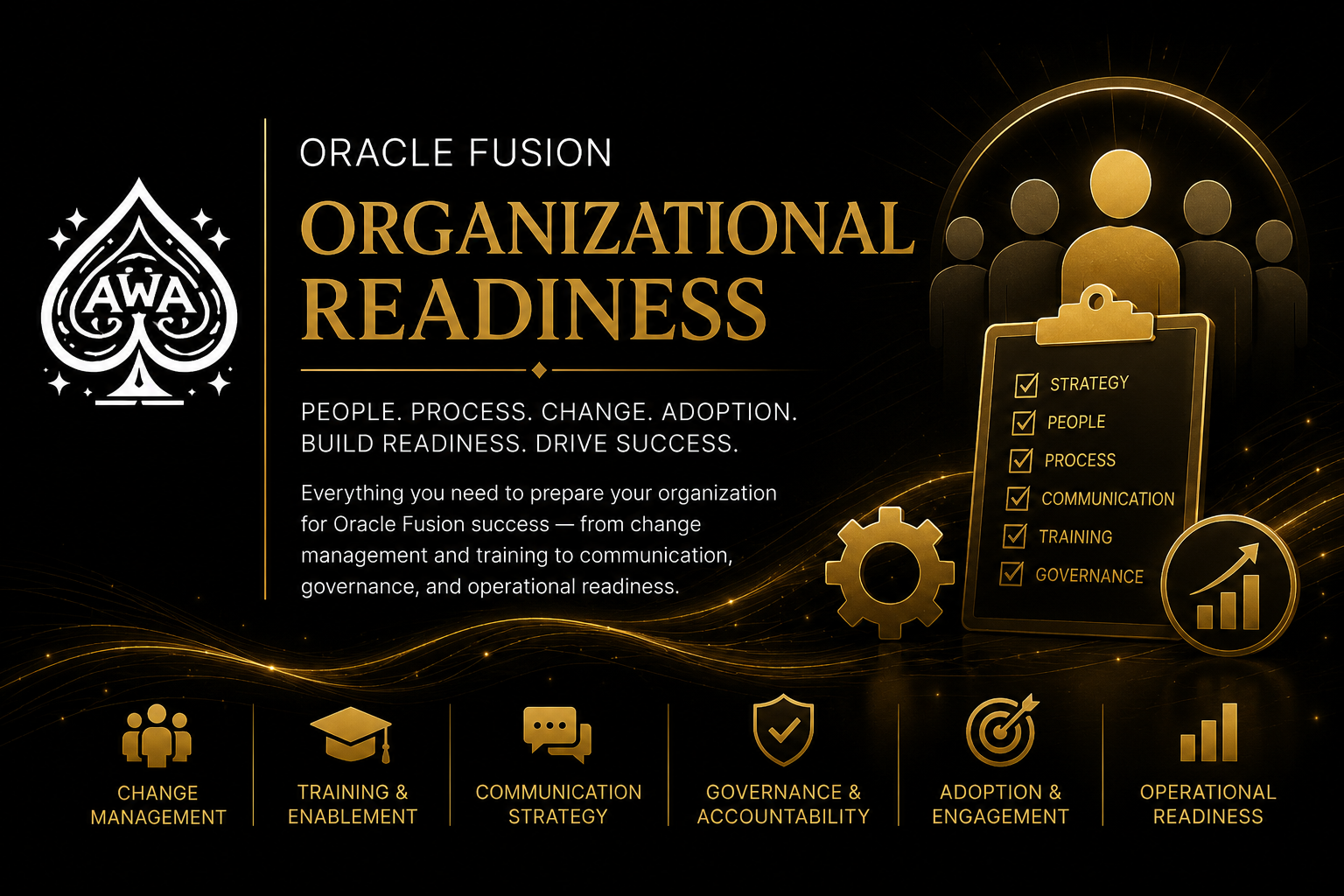
Organizational Readiness
Preparing Organizations, Stakeholders, Governance Structures, And Operational Teams For Oracle Fusion Success
Oracle Fusion implementations succeed when organizations prepare people and operations with the same level of discipline used to prepare technology.
Many ERP programs focus heavily on configuration, integrations, testing schedules, and deployment timelines while underestimating the operational disruption that occurs when organizations change the way people work, report, approve, communicate, and make decisions.
Organizational readiness is the process of aligning governance, operational expectations, stakeholder accountability, communications, reporting structures, training strategies, and executive sponsorship before go-live occurs.
The Organizational Readiness hub provides practical Oracle Fusion guidance focused on helping organizations improve operational preparedness, stakeholder alignment, governance discipline, user adoption, reporting confidence, and enterprise transformation success.
This hub is designed for:
- ERP program leaders
- implementation teams
- PMOs
- Finance leaders
- reporting organizations
- operational managers
- HR and business stakeholders
- governance leaders
- executive sponsors
Whether your organization is preparing for an Oracle Fusion implementation, stabilizing post-go-live operations, improving user adoption, or refining governance structures, organizational readiness plays a critical role in long-term ERP success.
Table of Contents
Why Organizational Readiness Matters
Oracle Fusion implementations change more than software screens.
They change operational behavior.
New ERP systems introduce new reporting structures, new approval models, new workflows, new accountability expectations, new governance frameworks, and new operational responsibilities.
Organizations that fail to prepare operational teams for those changes often experience confusion, resistance, reporting inconsistencies, weak adoption, governance instability, and support escalations shortly after go-live.
Many ERP programs incorrectly assume that completing system configuration automatically prepares the business for operational transition.
In reality, organizations must prepare people, governance structures, reporting expectations, support models, and operational processes long before deployment occurs.
Strong organizational readiness programs help organizations:
- improve stakeholder confidence
- reduce operational disruption
- improve user adoption
- strengthen governance discipline
- improve reporting trust
- reduce support escalations
- improve implementation stability
- improve executive visibility
Organizational readiness is not simply a training activity.
It is an operational transformation discipline that directly impacts long-term ERP adoption and enterprise stability.
ERP Transformation Is A People Transformation
One of the most important realities of Oracle Fusion implementations is that technology changes require people changes.
Employees must often adapt to:
- new approval processes
- new reporting expectations
- new operational responsibilities
- new dashboards and KPIs
- new governance models
- new financial controls
- new workflow ownership
- new accountability structures
Organizations that underestimate the human side of ERP transformation frequently experience resistance, confusion, inconsistent adoption, and operational instability.
Successful Oracle Fusion programs recognize that ERP transformation requires organizations to align people, process, governance, reporting, and operational ownership together.
Strong implementation teams spend significant time helping stakeholders understand:
- why processes are changing
- how operational responsibilities will evolve
- how reporting structures will improve visibility
- how governance expectations will change
- how departments will interact differently after go-live
This level of operational clarity improves adoption, strengthens accountability, and reduces organizational friction during deployment.
ERP transformation becomes significantly more stable when organizations prepare people for operational change instead of focusing exclusively on technical deployment.
Executive Sponsorship And Leadership Alignment
Strong executive sponsorship is one of the most important drivers of organizational readiness success.
Oracle Fusion implementations impact multiple departments simultaneously, including Finance, operations, reporting organizations, IT teams, HR teams, procurement groups, and executive leadership.
Without clear executive alignment, organizations frequently struggle with:
- conflicting priorities
- delayed decision-making
- governance instability
- stakeholder confusion
- inconsistent adoption
- operational silos
Executive sponsors help establish implementation credibility by reinforcing organizational priorities, governance expectations, reporting alignment, and operational accountability.
Leadership teams should consistently communicate:
- implementation objectives
- governance expectations
- reporting priorities
- operational responsibilities
- adoption expectations
- organizational benefits
Organizations that maintain strong executive visibility throughout implementation consistently experience smoother adoption and stronger operational alignment after go-live.
Executive sponsorship should remain active beyond deployment.
Operational transformation continues well after the system becomes technically available.
The organizations that achieve long-term Oracle Fusion success continue reinforcing governance, reporting expectations, accountability structures, and operational ownership after stabilization begins.
Communications Strategy And Stakeholder Alignment
Communication failures are one of the most common causes of ERP implementation instability.
Stakeholders become resistant when they do not understand:
- why changes are occurring
- how processes will evolve
- what operational responsibilities will change
- how reporting structures will improve visibility
- how decisions will be made after go-live
Organizations should establish communication strategies that remain active throughout the implementation lifecycle.
Strong communication programs provide consistent updates regarding:
- implementation milestones
- operational changes
- governance decisions
- testing progress
- reporting expectations
- training schedules
- deployment readiness
Communication strategies should not focus exclusively on project status.
They should reinforce operational alignment and organizational confidence.
Employees are more likely to support ERP transformation initiatives when they understand how changes improve reporting visibility, operational efficiency, governance discipline, and enterprise decision-making.
Stakeholder alignment improves significantly when communication remains transparent, consistent, and operationally focused.
Training Must Be Operationally Focused
Many ERP training programs fail because they focus on software navigation instead of operational execution.
Organizations frequently train users on where to click without explaining:
- why processes exist
- how workflows support governance
- how reporting structures improve visibility
- how approvals impact operational accountability
- how departments interact operationally
Strong Oracle Fusion training programs connect system functionality to real operational responsibilities.
Users should understand:
- operational workflows
- approval responsibilities
- reporting expectations
- governance requirements
- reconciliation responsibilities
- dashboard visibility
- escalation procedures
Training programs should include realistic operational scenarios that help users understand how Oracle Fusion supports enterprise processes.
Organizations that align training with operational outcomes consistently improve adoption, reduce support escalations, and strengthen governance discipline.
Training should also remain active after go-live.
Many organizations underestimate the importance of reinforcement training during stabilization phases.
Operational confidence improves significantly when users continue receiving guidance as real-world ERP usage expands.
Reporting Visibility Builds Organizational Confidence
One of the fastest ways to improve ERP adoption is helping organizations see meaningful reporting improvements.
Employees, managers, Finance teams, and executives become more supportive of ERP transformation initiatives when they gain improved visibility into operations, reporting accuracy, dashboards, KPIs, reconciliations, and enterprise performance.
Organizations should align reporting readiness with organizational readiness.
Operational teams should understand:
- how dashboards improve visibility
- how KPIs support accountability
- how reporting structures improve decision-making
- how analytics support operational efficiency
- how Financials visibility improves governance
Strong reporting alignment increases organizational trust in the ERP environment.
Organizations that delay reporting readiness frequently experience confusion, reporting inconsistency, KPI distrust, and operational frustration after go-live.
Oracle Fusion adoption improves significantly when operational teams experience reporting improvements early in the implementation lifecycle.
Governance And Operational Accountability
Organizational readiness depends heavily on governance discipline.
Organizations should establish clear accountability structures covering:
- approvals
- reporting ownership
- operational signoffs
- escalation paths
- support responsibilities
- KPI governance
- reconciliation ownership
- decision authority
Weak governance creates uncertainty.
Operational teams become frustrated when responsibilities remain unclear or inconsistent after go-live.
Strong governance models improve:
- implementation consistency
- reporting trust
- operational alignment
- executive visibility
- adoption confidence
- stakeholder accountability
Governance structures should remain active after deployment.
Organizations that treat governance as a temporary implementation exercise frequently experience long-term operational instability.
Successful Oracle Fusion organizations continue reinforcing governance expectations throughout operational maturity.
Testing And Operational Readiness
Testing should reinforce organizational readiness—not operate independently from it.
Oracle Fusion testing activities provide organizations with opportunities to validate:
- workflows
- reporting accuracy
- operational ownership
- approval structures
- dashboards
- reconciliations
- support processes
- governance expectations
Testing programs should involve real business stakeholders using realistic operational scenarios.
This improves:
- user confidence
- operational understanding
- adoption readiness
- reporting trust
- governance alignment
Organizations that isolate testing from operational readiness frequently discover adoption problems after go-live.
Testing should help organizations build operational confidence before deployment occurs.
The strongest Oracle Fusion implementations treat testing as both a technical validation process and an organizational readiness discipline.
Organizational Readiness Best Practices
Successful Oracle Fusion organizational readiness programs consistently:
- align executive sponsors early
- establish governance accountability
- communicate operational changes clearly
- align reporting expectations
- reinforce operational ownership
- provide realistic training scenarios
- involve stakeholders during testing
- reinforce adoption after go-live
- connect ERP changes to operational outcomes
Organizations that prioritize operational readiness consistently achieve:
- stronger adoption
- smoother deployments
- improved reporting trust
- reduced support escalations
- improved governance discipline
- better executive visibility
- stronger ERP transformation outcomes
Technology alone does not create successful ERP environments.
Long-term Oracle Fusion success requires organizations to align people, governance, reporting, operational ownership, and accountability into a unified operational strategy.
Featured Oracle Fusion Webinar Series
Watch practical Oracle Fusion webinars covering:
- organizational readiness
- change management
- stakeholder engagement
- governance methodologies
- reporting strategy
- dashboards and KPI governance
- testing and validation
- Financials governance
- ERP transformation best practices
Why Afternoons With ACEs
Afternoons With ACEs provides practical Oracle Fusion implementation guidance focused on helping organizations improve governance, reporting visibility, operational readiness, stakeholder alignment, Financials integrity, testing discipline, and enterprise ERP transformation success.
The focus is practical implementation execution—not theoretical consulting terminology.
Organizations succeed when people, governance, reporting, operational accountability, and ERP strategy work together.
Related Oracle Fusion Hub Pages
- Change Management
- Stakeholder Engagement
- Governance And Methodology
- Testing And Validation
- Reporting Strategy
- KPI Governance
- Financial Governance
- Dashboards
- Implementation Strategy
About Afternoons With ACEs
Afternoons With ACEs provides Oracle Fusion implementation guidance from Oracle ACE Professionals Lee Briggs and Thomas Simkiss.
Topics include:
- organizational readiness
- governance methodologies
- stakeholder engagement
- reporting strategy
- dashboards and KPI governance
- testing and validation
- Financials governance
- ERP best practices
Practical implementation guidance. Real-world ERP experience. Enterprise Oracle Fusion success strategies.Organizational Readiness