
Reporting Strategy Series – Part 2 of 3
Welcome to Part 2 of the Afternoons With ACEs Reporting Strategy Series.
In Part 1, we explored the differences between OTBI and SmartView and discussed how each reporting tool serves a distinct purpose within an Oracle Fusion reporting strategy.
One of the key conclusions from that discussion was that reporting success is rarely determined by the technology itself. Instead, successful reporting strategies begin with understanding who will consume the information and how they intend to use it.
This article explores the concept of reporting personas and explains why aligning reporting solutions to user needs is one of the most important factors in Oracle Fusion reporting success.
Part 1: OTBI vs SmartView: Which Oracle Fusion Reporting Tool Should You Use?
Part 2: Understanding Oracle Fusion Reporting Personas: Matching Reporting Tools to User Needs (This Article)
Part 3: Why Reporting Requirements Should Drive Oracle Fusion Design Decisions
Why Reporting Personas Matter
One of the most common mistakes made during Oracle Fusion implementations is treating reporting as though every user has identical requirements.
Project teams frequently focus on reporting technology before understanding reporting consumers. Conversations quickly turn to OTBI, SmartView, dashboards, security models, and reporting tools while spending very little time discussing who actually needs information and how that information will support business decisions.
The result is predictable. Organizations often deploy reporting solutions that are technically sound but poorly aligned to user expectations. Executives receive detailed transactional reports they never read. Finance teams are forced into dashboards when they need analytical flexibility. Operational managers receive summary information when they require transaction-level visibility.
The issue is not the reporting technology. The issue is that reporting requirements were never aligned to the needs of the people consuming the information.
Successful Oracle Fusion reporting strategies begin by identifying reporting personas.
A reporting persona represents a group of users who consume information in similar ways, make similar decisions, and require similar reporting capabilities.
Understanding these personas allows implementation teams to select the appropriate reporting tools, design effective reporting solutions, and improve user adoption after go-live.
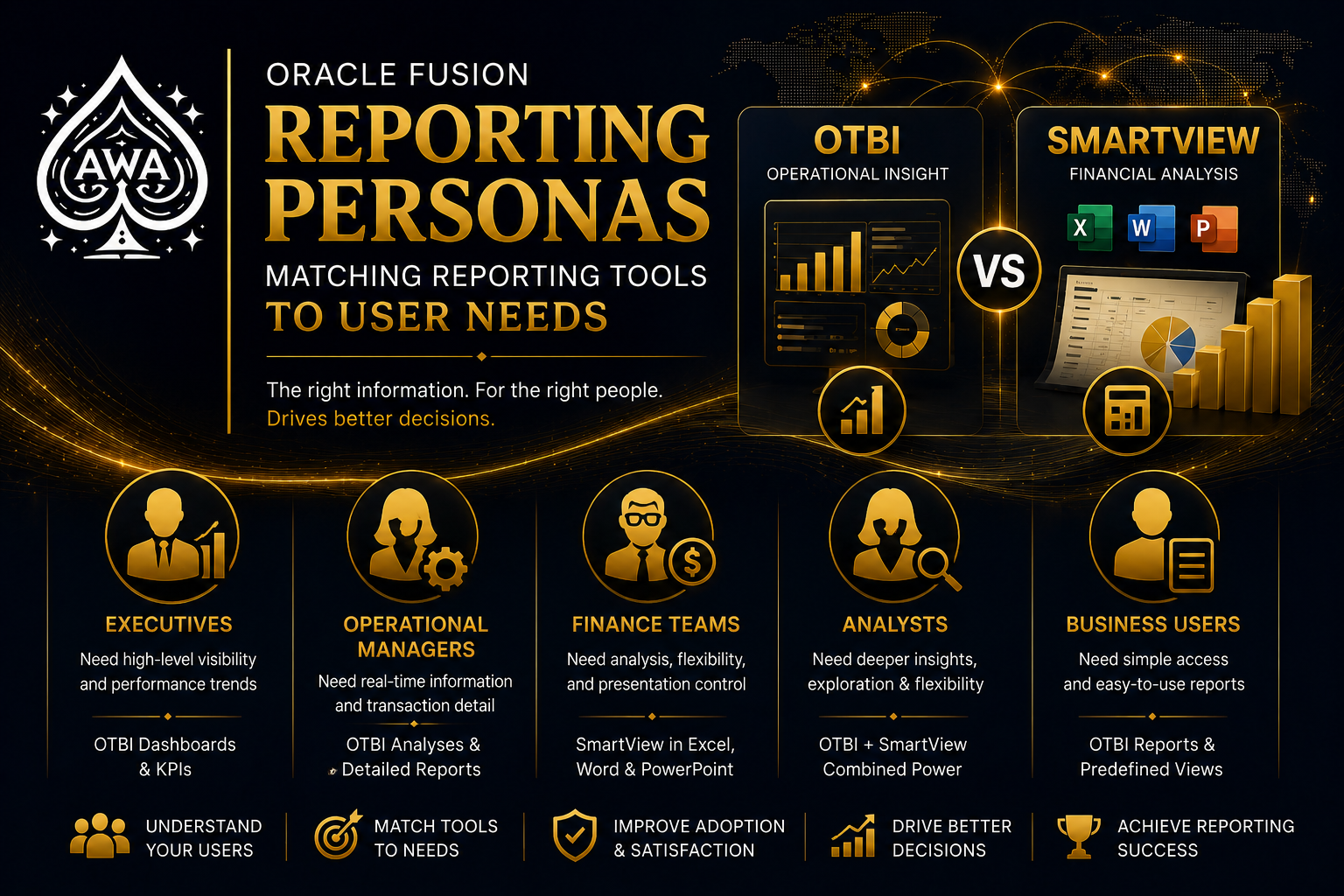
The Executive Persona
Executives typically consume information differently than almost any other user group.
Chief Financial Officers, Finance Directors, Chief Operating Officers, and executive leadership teams rarely need transaction-level detail. Their primary concern is understanding organizational performance, identifying trends, monitoring key metrics, and making strategic decisions.
Executives generally want answers to questions such as:
- Are we achieving our financial objectives?
- What risks require attention?
- Which business areas are performing well?
- Where should we focus management attention?
- How are we performing against targets?
Because executive users are focused on outcomes rather than transactions, they often benefit most from dashboards, visualizations, scorecards, and key performance indicators.
For this reason, OTBI dashboards are frequently the most effective reporting solution for executive users.
A well-designed executive dashboard provides rapid visibility into business performance while minimizing the need to navigate detailed reports.
The objective is not to provide more information. The objective is to provide the right information.
The Operational Manager Persona
Operational managers sit much closer to daily business activity than executives.
Accounts Payable managers, Procurement managers, Project managers, HR managers, and Operations leaders often need immediate visibility into current transactions and operational performance.
Unlike executives, these users frequently require detailed information to understand why performance indicators are changing.
An Accounts Payable manager may need visibility into:
- Invoice backlogs
- Aging transactions
- Approval bottlenecks
- Supplier activity
- Exception processing
Similarly, Procurement managers may need insight into purchase orders, supplier performance, requisitions, and spending activity.
These users often need both summary information and transaction-level detail.
OTBI is typically the ideal solution for operational managers because it combines real-time visibility with self-service reporting capabilities. Managers can monitor performance while also investigating underlying transactions when exceptions occur.
The Finance Team Persona
Finance professionals often represent the most demanding reporting audience within an Oracle Fusion implementation.
Controllers, Financial Analysts, Accounting Managers, and Finance Directors routinely perform activities that extend far beyond standard operational reporting.
Their responsibilities frequently include:
- Financial statement analysis
- Variance reporting
- Budget reviews
- Forecasting
- Period close activities
- Executive reporting packs
- Regulatory reporting
These activities require flexibility, formatting control, comparative analysis, and the ability to perform sophisticated calculations.
This is where SmartView often becomes the preferred reporting solution.
Because SmartView integrates directly with Microsoft Office applications, finance teams can combine Oracle Fusion information with existing reporting processes while maintaining the analytical flexibility required for complex financial reporting.
The question is not whether finance teams can use OTBI. They certainly can.
The better question is whether OTBI provides the flexibility finance teams require to perform their responsibilities effectively.
In many cases, SmartView becomes the natural choice.
The Analyst Persona
Business analysts and reporting specialists occupy a unique position within the organization.
Unlike executives who primarily consume information or operational managers who focus on current activity, analysts are often responsible for understanding patterns, identifying opportunities, and supporting business decisions through data.
Analysts frequently ask questions that were not anticipated during report design.
They may need to:
- Investigate trends
- Explore anomalies
- Compare business units
- Analyze historical performance
- Support strategic initiatives
These requirements often demand a combination of reporting tools.
OTBI may provide the initial data source while SmartView supports deeper analysis.
Organizations that understand analyst requirements often provide access to multiple reporting solutions rather than restricting users to a single tool.
The Casual Business User Persona
Not every user requires sophisticated reporting capabilities.
Many employees simply need access to information that helps them perform their daily responsibilities.
These users typically want:
- Easy access
- Simple navigation
- Minimal training
- Standardized reports
- Consistent information
For these users, simplicity is often more important than flexibility.
OTBI dashboards and predefined reports generally provide the best user experience because they minimize complexity while delivering the information required to support daily activities.
Organizations frequently overestimate reporting sophistication requirements and underestimate the importance of usability.
A report that is easy to access and understand will often deliver more value than a highly sophisticated report that users avoid.
Why One Reporting Tool Rarely Fits Every User
One of the most damaging assumptions made during implementations is that standardization requires a single reporting tool.
This often leads organizations to force every user community into the same reporting platform regardless of their needs.
- The result is predictable.
- Executives receive excessive detail.
- Finance teams lose analytical flexibility.
- Operational managers struggle to obtain transaction-level visibility.
- Analysts create workarounds.
- Users become frustrated.
The problem is not the reporting platform – the problem is the assumption that different reporting personas have identical requirements.
Successful organizations recognize that reporting ecosystems are most effective when multiple tools work together to support different user communities.
Building a Persona-Driven Reporting Strategy
Organizations should begin reporting design by identifying the major reporting personas that exist within the business.
Questions that should be asked include:
- Who consumes information?
- What decisions do they make?
- How frequently do they consume information?
- Do they require detail or summaries?
- Do they perform analysis or simply consume information?
- What tools are they already comfortable using?
Once reporting personas have been identified, reporting solutions can be aligned to user needs.
This approach significantly improves adoption, reduces reporting dissatisfaction, and increases the likelihood of long-term reporting success.
Most importantly, it shifts reporting discussions away from technology and toward business outcomes.
Final Thoughts
Technology alone does not create reporting success.
Understanding users creates reporting success.
Organizations that begin reporting design by understanding reporting personas are far more likely to deliver reporting solutions that support decision-making, improve adoption, and generate long-term business value.
The most successful Oracle Fusion reporting environments are not built around tools – they are built around people.
When reporting strategies focus on user needs first and technology second, organizations create reporting ecosystems that are both effective and sustainable.
Continue the Reporting Strategy Series
Understanding reporting personas is an important step toward building an effective reporting strategy.
However, reporting success depends on more than selecting the right tool for the right audience.
Organizations must also ensure that reporting requirements influence design decisions throughout the implementation lifecycle.
In the next article, we’ll explore why reporting requirements should be defined early and how reporting considerations should influence Chart of Accounts design, security models, organizational structures, and implementation decisions.
Next Article:
Why Reporting Requirements Should Drive Oracle Fusion Design Decisions
Topics include:
- Reporting-driven implementation strategy
- Chart of Accounts design considerations
- Security and reporting alignment
- Organizational structures and reporting
- Lessons learned from Oracle Fusion implementations
- Avoiding reporting surprises after go-live