
OTBI Troubleshooting
Oracle Transactional Business Intelligence Troubleshooting, Reporting Governance, Analytics Visibility, And Reporting Integrity
Oracle Transactional Business Intelligence (OTBI) is one of the most powerful reporting capabilities within Oracle Fusion Applications.
When OTBI environments are configured correctly, organizations gain real-time operational visibility, stronger analytics governance, improved executive reporting, scalable dashboard frameworks, and better enterprise decision-making.
When OTBI environments are poorly governed, organizations frequently experience reporting inconsistencies, missing data, hierarchy issues, flexfield synchronization problems, dashboard instability, security confusion, and reduced trust in reporting outputs.
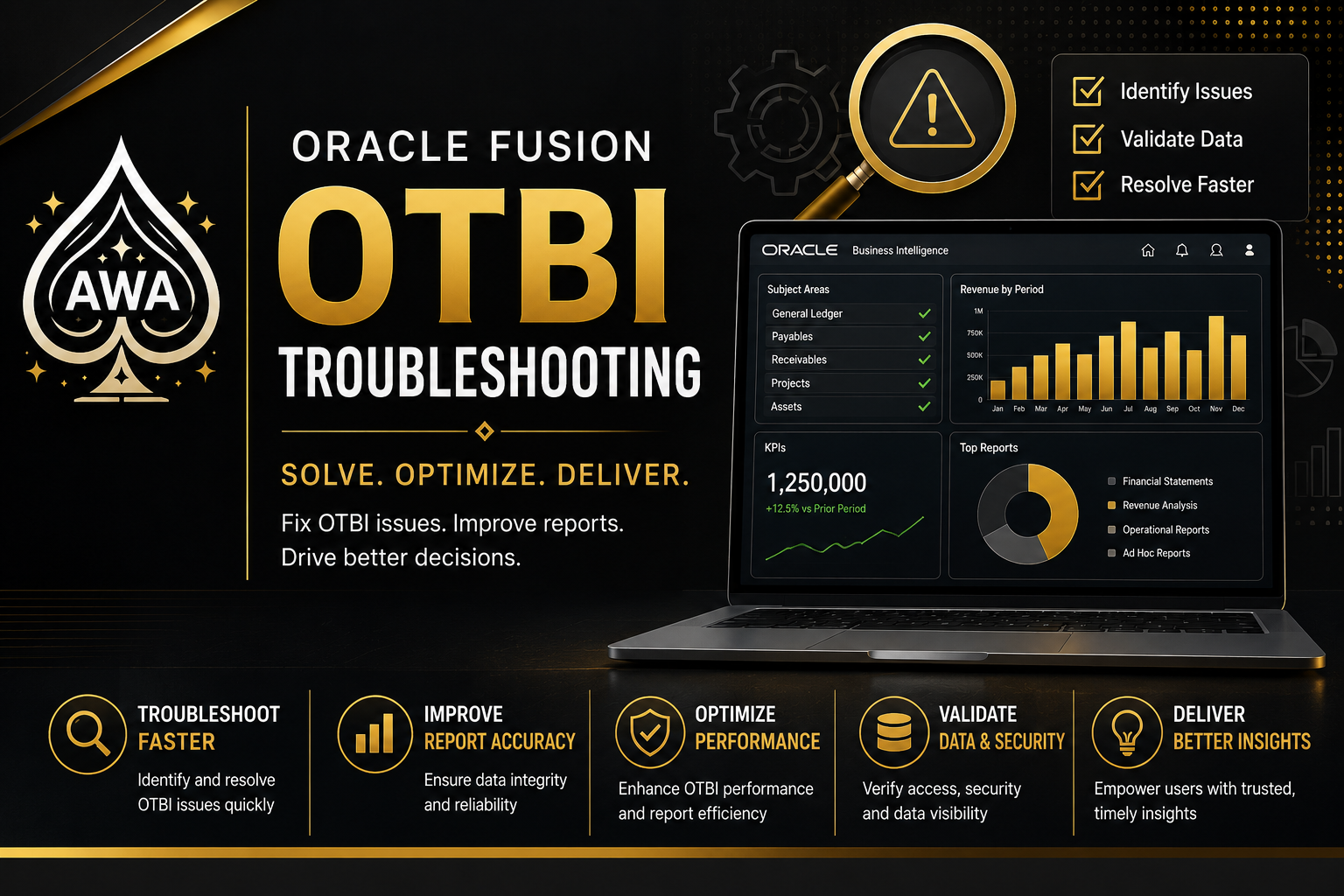
The OTBI Troubleshooting hub provides practical Oracle Fusion reporting guidance focused on diagnosing reporting issues, improving analytics governance, stabilizing dashboards, improving reporting visibility, and strengthening enterprise reporting integrity.
This hub is designed for:
- Oracle Fusion reporting teams
- OTBI developers
- ERP implementation teams
- Financials reporting teams
- dashboard developers
- analytics teams
- ERP administrators
- operational reporting stakeholders
- governance leaders
Whether your organization is troubleshooting missing OTBI data, stabilizing dashboard visibility, refining reporting governance, improving hierarchy alignment, or strengthening analytics consistency, this hub provides practical Oracle Fusion OTBI troubleshooting strategies focused on real-world enterprise reporting success.
Table of Contents
Why OTBI Troubleshooting Matters
Reporting trust is one of the most important components of successful Oracle Fusion environments.
Organizations depend on OTBI to provide:
- executive visibility
- operational reporting
- KPI monitoring
- Financials reporting
- dashboard analytics
- reconciliation visibility
- management reporting
- operational accountability
When reporting outputs become inconsistent or unreliable, stakeholder confidence deteriorates quickly.
Operational teams begin questioning:
- dashboard accuracy
- KPI consistency
- hierarchy integrity
- reporting governance
- Financials visibility
- analytics reliability
Many OTBI issues are not caused by reporting tools themselves.
They are typically symptoms of broader governance, configuration, hierarchy, security, or operational alignment problems.
Organizations that establish strong reporting governance frameworks consistently experience:
- more stable dashboards
- cleaner reporting outputs
- improved analytics trust
- stronger executive visibility
- better operational accountability
- reduced troubleshooting effort
OTBI troubleshooting should not focus exclusively on fixing isolated reports.
It should focus on strengthening long-term reporting integrity across the enterprise.
Reporting Governance Is The Foundation Of Stable OTBI Environments
One of the most common causes of OTBI instability is weak reporting governance.
Organizations frequently build reports, dashboards, and analytics structures without establishing consistent governance standards around:
- KPI ownership
- hierarchy governance
- reporting definitions
- dashboard standards
- naming conventions
- security alignment
- operational accountability
Without governance discipline, reporting environments become inconsistent over time, different departments begin interpreting metrics differently, dashboard logic diverges, hierarchy structures drift, and Stakeholders lose confidence in analytics outputs.
Strong reporting governance establishes:
- standardized reporting definitions
- consistent KPI ownership
- dashboard accountability
- hierarchy alignment
- analytics consistency
- operational reporting standards
Organizations that treat OTBI governance as an enterprise discipline consistently achieve stronger reporting trust and better executive visibility.
OTBI environments become significantly easier to troubleshoot when governance structures are clear and operationally aligned.
Flexfield Synchronization Issues
One of the most common Oracle Fusion OTBI troubleshooting scenarios involves descriptive flexfields (DFFs), extensible flexfields (EFFs), or key flexfields not appearing correctly within OTBI subject areas.
Organizations frequently experience situations where:
- new fields do not appear in OTBI
- flexfield values display inconsistently
- attributes are missing from dashboards
- metadata changes fail to synchronize
- reports return incomplete data
In many cases, the underlying issue is related to metadata synchronization and deployment sequencing.
OTBI subject areas depend on properly synchronized metadata layers.
When flexfield deployments, metadata refreshes, or BI extensions are incomplete, reporting outputs frequently become inconsistent.
Organizations should establish disciplined governance around:
- flexfield deployment procedures
- metadata refresh schedules
- reporting validation processes
- OTBI synchronization testing
- operational signoffs
Strong reporting governance reduces the likelihood of synchronization instability and improves long-term analytics reliability.
OTBI troubleshooting becomes significantly easier when metadata governance processes remain standardized and repeatable.
Security And Data Visibility Issues
Security alignment is another major source of OTBI troubleshooting complexity.
Organizations frequently encounter reporting issues where:
- users cannot see expected data
- dashboards return incomplete results
- security roles produce inconsistent visibility
- data access differs between users
- reporting outputs vary unexpectedly
Many of these issues originate from misalignment between Oracle Fusion security structures and reporting expectations.
OTBI visibility depends heavily on:
- data security roles
- business unit alignment
- ledger access
- organizational hierarchies
- duty roles
- reporting security structures
Organizations should validate reporting visibility operationally—not simply technically.
Users should confirm:
- dashboard visibility
- operational reporting access
- Financials visibility
- hierarchy alignment
- cross-functional reporting consistency
before deployment occurs.
Strong governance around security and reporting access significantly improves reporting trust across the enterprise.
Organizations that delay security validation often experience substantial reporting confusion after go-live.
Hierarchy And Organizational Alignment Problems
Many OTBI reporting problems originate from hierarchy instability.
Reporting environments depend heavily on consistent organizational structures.
When hierarchies become misaligned, organizations frequently experience:
- inconsistent rollups
- dashboard discrepancies
- missing data
- KPI inconsistencies
- operational reporting confusion
- Financials reporting instability
Organizations should align:
- department hierarchies
- cost center structures
- business unit relationships
- security structures
- reporting hierarchies
- dashboard logic
before reports are finalized.
One of the most important Oracle Fusion reporting best practices is ensuring organizational structures align operationally across ERP and HCM environments.
When organizational structures diverge, reporting inconsistencies become significantly more difficult to troubleshoot.
Strong hierarchy governance improves:
- dashboard stability
- reporting consistency
- executive visibility
- KPI trust
- Financials integrity
- analytics scalability
Organizations that prioritize hierarchy governance early consistently create stronger OTBI environments.
Dashboard Stability And KPI Governance
Dashboards are only valuable when organizations trust the KPIs displayed within them.
Many organizations build dashboards rapidly during implementation phases without establishing long-term governance around:
- KPI ownership
- reporting definitions
- dashboard maintenance
- operational accountability
- reporting refresh expectations
- executive visibility standards
Over time, dashboards frequently become inconsistent.
Stakeholders begin questioning:
- which metrics are correct
- why dashboards differ
- how KPIs are calculated
- whether reporting outputs are trustworthy
Strong KPI governance establishes operational accountability around analytics consistency.
Organizations should define:
- KPI ownership
- reporting standards
- dashboard governance
- escalation procedures
- validation responsibilities
- executive reporting expectations
OTBI troubleshooting becomes significantly easier when dashboard governance remains operationally disciplined.
Stable KPI governance improves reporting trust across the organization.
OTBI Performance Troubleshooting
Performance issues are another common challenge within large Oracle Fusion reporting environments.
Organizations frequently experience:
- slow dashboard performance
- delayed report execution
- large data retrieval delays
- inefficient filtering
- excessive query complexity
- overloaded dashboards
Many performance problems originate from reporting design decisions rather than infrastructure limitations.
Organizations should establish reporting design standards covering:
- filtering strategies
- dashboard simplicity
- report efficiency
- data retrieval governance
- visualization standards
- operational usability
OTBI reports should support operational decision-making—not overwhelm users with excessive complexity.
Strong dashboard governance improves both performance and usability.
Organizations that prioritize reporting simplicity frequently create faster, more scalable OTBI environments.
Operational reporting should focus on delivering actionable visibility rather than displaying every available data element simultaneously.
OTBI Troubleshooting Best Practices
Successful Oracle Fusion reporting organizations consistently:
- establish reporting governance early
- align hierarchies operationally
- validate reporting visibility before go-live
- synchronize metadata consistently
- establish KPI ownership
- validate dashboard outputs operationally
- align security with reporting expectations
- reinforce analytics governance after deployment
Organizations that prioritize reporting integrity consistently improve:
- executive visibility
- reporting trust
- dashboard consistency
- operational accountability
- Financials visibility
- ERP adoption
OTBI troubleshooting should focus on strengthening enterprise reporting discipline—not simply fixing isolated reports.
The organizations that achieve long-term analytics success establish scalable governance frameworks that align reporting, operations, Financials, dashboards, security, and executive visibility into a unified reporting strategy.
Reporting Strategy And OTBI Success
Strong OTBI environments are built on strong reporting strategies.
Organizations that treat reporting as a secondary implementation activity frequently experience:
- dashboard instability
- inconsistent KPIs
- reporting gaps
- executive visibility limitations
- governance confusion
Reporting strategy should influence:
- Chart of Accounts design
- hierarchy structures
- dashboard planning
- KPI governance
- security alignment
- organizational accountability
before operational processes are finalized.
The organizations that achieve the strongest Oracle Fusion reporting environments align reporting strategy with implementation governance from the beginning of the ERP lifecycle.
OTBI becomes significantly more scalable and trustworthy when reporting governance remains operationally aligned across the enterprise.
Featured Oracle Fusion Webinar Series
Watch practical Oracle Fusion webinars covering:
- OTBI troubleshooting
- reporting governance
- dashboards and KPI governance
- SmartView reporting
- Financials visibility
- analytics strategy
- reporting best practices
- hierarchy governance
- ERP reporting frameworks
[BUTTON — Subscribe On YouTube]
Why Afternoons With ACEs
Afternoons With ACEs provides practical Oracle Fusion implementation guidance focused on improving reporting visibility, governance discipline, dashboard consistency, Financials integrity, analytics trust, and enterprise ERP transformation success.
The focus is practical reporting execution—not theoretical consulting terminology.
Organizations succeed when reporting governance, dashboards, KPIs, operational visibility, and ERP strategy operate together.
Related Oracle Fusion Hub Pages
- Reporting Strategy
- Reporting And Analytics
- Dashboards
- KPI Governance
- SmartView
- Financial Reporting
- Chart Of Accounts Design
- Financial Governance
- Implementation Strategy
About Afternoons With ACEs
Afternoons With ACEs provides Oracle Fusion implementation guidance from Oracle ACE Professionals Lee Briggs and Thomas Simkiss.
Topics include:
- OTBI troubleshooting
- reporting governance
- dashboards and KPI visibility
- SmartView reporting
- Financials governance
- reporting strategy
- analytics frameworks
- ERP best practices
Practical implementation guidance. Real-world ERP experience. Enterprise Oracle Fusion success strategies.