
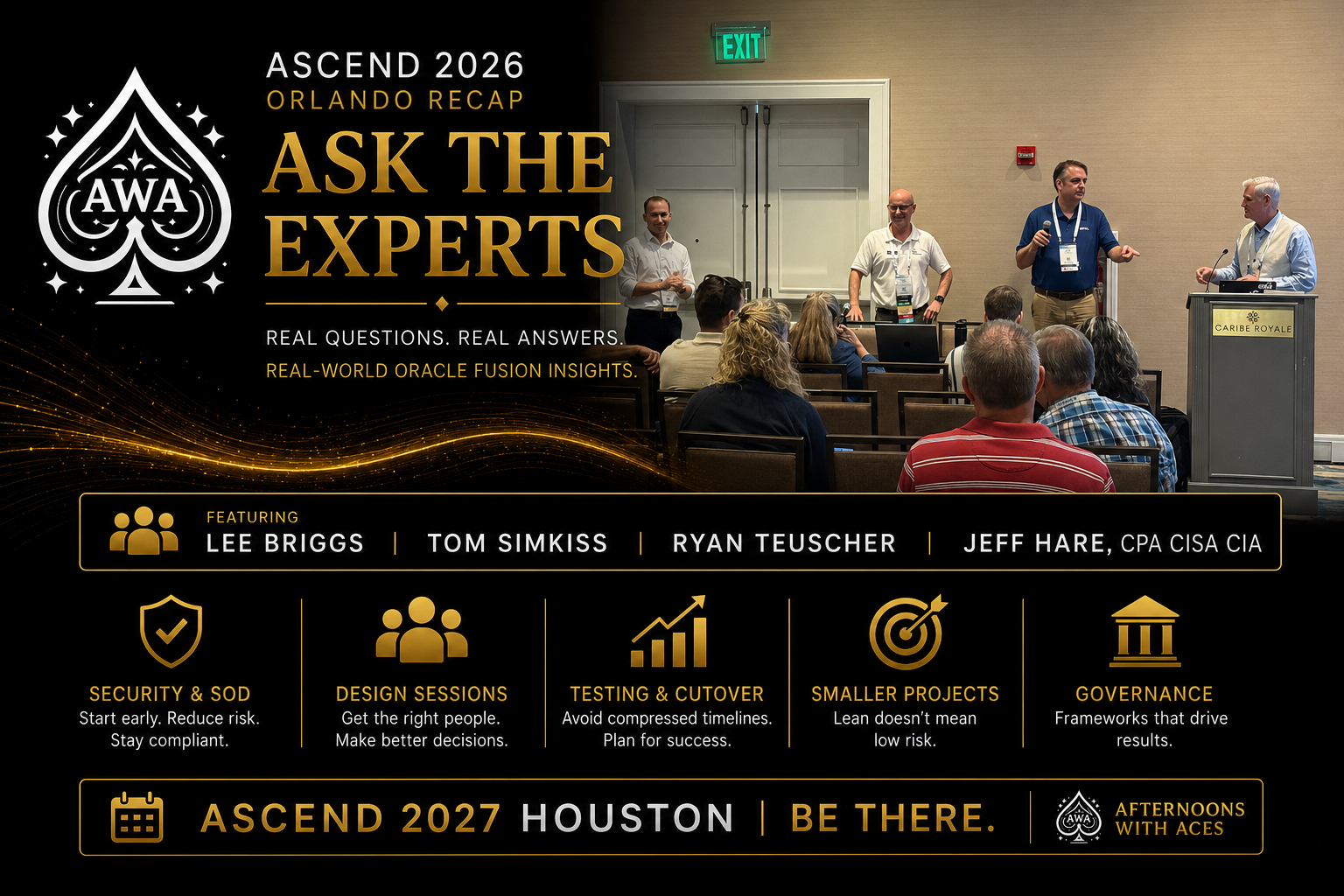
OATUG Ascend 2026 was in Orlando in June. We were there. If you weren’t, read this and start planning for Houston in 2027.
Tom moderated a session called “Ask the Experts” alongside Lee Briggs, Ryan Teuscher, and Jeff Hare, CPA CISA CIA, CEO and founder of ERP Risk Advisors. The four of us have a few hundred combined years of Oracle ERP, HCM, and security experience between us. We had a deck. We barely used it.
That’s not a complaint. That’s the point.
The Session Was a Q&A. Real Questions. No Softballs.
We framed three topics to anchor the conversation: design sessions, security and segregation of duties, and the pitfalls that kill smaller implementations. But the audience drove everything after the intro.
People brought actual problems. Not hypotheticals. Not vendor-speak questions dressed up to sound smart. Real situations from real projects that were live, in flight, or already in trouble.
That’s what you get when you put a room full of Oracle practitioners together at a conference. People who are in the middle of something hard want to talk to people who have been in the middle of something hard. That’s the deal.
Jeff fielded most of the security questions. He has spent his career focused on ERP controls, SoD risk, and audit exposure, and he gave straight answers. Not marketing. Not “it depends” without a follow-up. Actual guidance.
Ryan handled the HCM side. Position management, payroll design, workforce analytics. Specific answers to specific situations.
Lee and Tom covered ERP design, implementation structure, project governance, and what goes wrong when teams skip the steps that feel like overhead until something breaks.
What the Room Was Asking About
The questions covered a lot of ground. A few themes kept coming up.
Security came up constantly. When to start SoD planning. How to avoid getting to UAT and discovering that role design conflicts are everywhere. What it actually costs to fix security problems post go-live versus during design. Jeff was direct on all of it: if you are not thinking about security in your first design session, you are already late.
Design sessions came up too. What makes one work versus what makes one a waste of everyone’s time. How to get the right people in the room and keep them there. How to document decisions in real time so the conversation doesn’t evaporate. Lee and Ryan both had strong opinions on this, and the audience did too.
Testing and cutover came up more than once. Specifically, what happens when the testing window gets compressed because something else in the schedule slipped. The answer is never good, and everyone in the room knew it from experience.
Smaller implementations got their own thread. There’s a common assumption that a smaller project carries less risk. It doesn’t. Lean teams, tight timelines, and part-time business resources create their own category of failure. We talked through what that looks like and what to do about it.
Where We Gave Guidance and Where We Pointed People Elsewhere
We were honest when we could give a direct answer and honest when we couldn’t. Some situations needed more context than a conference session allows. Some required someone to look at the actual configuration, the actual org structure, the actual data. We said so.
A few times we gave a suggestion and told people to go talk to a specialist. Jeff was particularly good at this. He knows exactly where the line is between general guidance and something that requires a real engagement. That’s experience talking.
The discussion continued after the session ended. People came up with follow-on questions. Swag was handed out, courtesy of SC&H Group. Good conversations happened in the hallway after and at the lunch that followed.
That’s what in-person attendance does. The session ends. The conversation doesn’t.
The Podcast Series Is Coming
A number of the topics that came up in Orlando didn’t get the time they deserved. That’s the nature of a Q&A session with a live audience and a clock on the wall.
This summer, Lee and Tom are recording a new series of Afternoons With ACEs podcast episodes that will go deeper on what came up in Orlando. Some of those topics were on our list going in. Others came from the audience.
We’ll go through design sessions, security architecture, SoD strategy, what kills smaller implementations, and more. Topics that deserve a real conversation, not a five-minute conference answer.
Watch the Afternoons With ACEs YouTube channel and follow along as the series drops.
Go to Ascend 2027. Houston. Be There.
Ascend 2026 in Orlando was worth the trip. The sessions are good. The hallway conversations are better. The people you meet are the ones solving the same problems you are solving, on the same platforms, at the same scale.
The OATUG community exists because Oracle ERP is complex and the people doing the work need each other. That’s not a pitch. That’s just true.
Ascend 2027 is in Houston. Put it on the calendar now. Get the approval now. Don’t wait until April and find out the budget is gone.
If you want to talk Oracle Fusion, ERP design, security, or implementation strategy before then, find us on LinkedIn and on Social Media (links are here). The podcast series will be out this summer.
The room in Orlando was full of people who showed up to get better at their jobs. That’s the right instinct. Keep doing that.